|
Get ahead. Get the online training, certification programs, and policy tool kits |

NIST Cybersecurity Framework 2.0 Lead Implementer Training (30 Days)
SKU CSF_LI. Get trained and certified as an expert in developing, implementing, and managing a robust cybersecurity program according to internationally adopted NIST CSF governance and management best practices. This course subscription provides 30 days of access to prerequisite training for CIS exam #CSF101. As this is a subscription-based course, no permanent download of course materials is provided. This subscription does NOT auto-renew.
Sales price $399.95
Discount
Total discount:
Description
| Terms of Service: Unlimited online utilization of this course is provided for a single user for 30 days in duration from the time of purchase according to the terms of Certified Information Security's End-User License Agreement. The subscription expires 30 days after purchase. Subscription time is not banked, and cannot be "frozen", deferred, or re-scheduled. As this is a subscription-based course, no permanent download of course materials is provided. This subscription does NOT auto-renew. |
Get trained and certified as an expert in
implementing and managing cybersecurity according to
NIST Cybersecurity Framework (CSF) 2.0
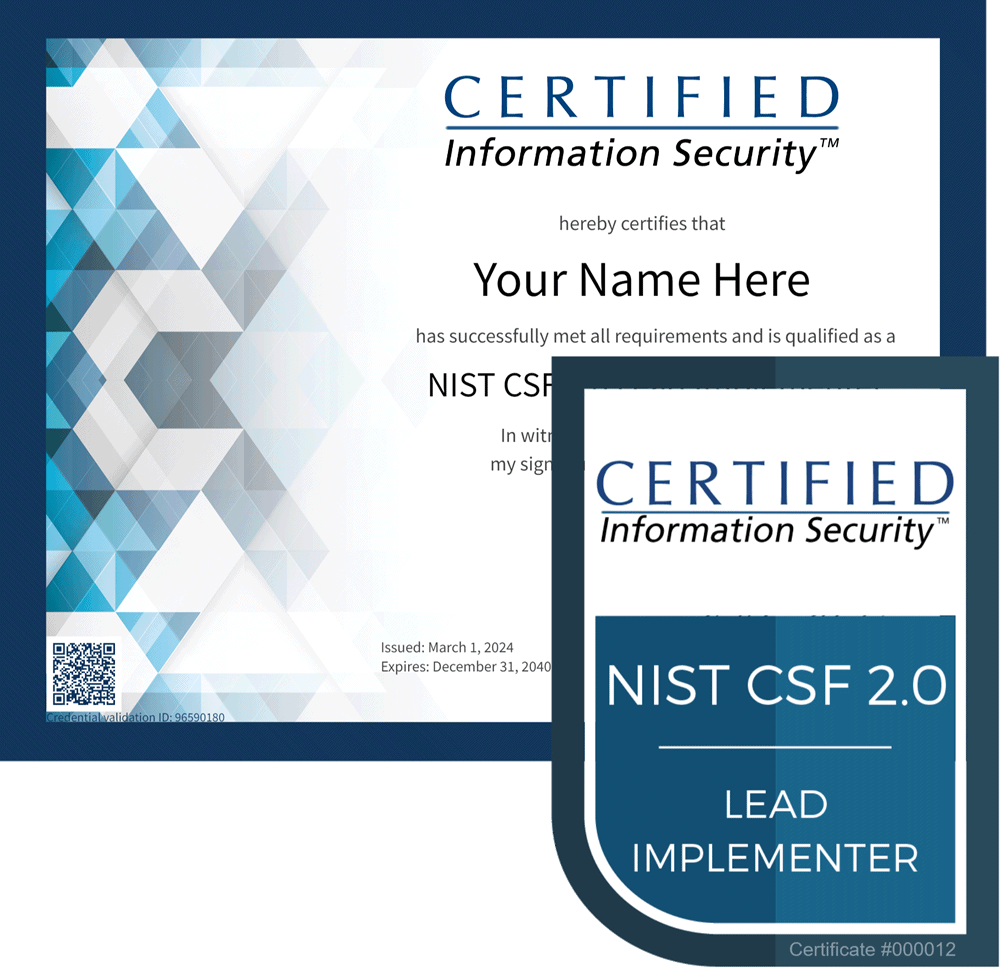 The Certified NIST CSF 2.0 LI certification certifies your ability to implement the formal structure, governance, and policy of a robust cybersecurity framework following internationally recognized and respected NIST best practices and standards. Get trained and certified as an expert in developing, implementing, and managing a robust cybersecurity program according to internationally adopted NIST CSF governance and management best practices. Completion of this course fulfills all prerequisite training requirements for CIS exam #CSF101. The Certified NIST CSF 2.0 LI certification certifies your ability to implement the formal structure, governance, and policy of a robust cybersecurity framework following internationally recognized and respected NIST best practices and standards. Get trained and certified as an expert in developing, implementing, and managing a robust cybersecurity program according to internationally adopted NIST CSF governance and management best practices. Completion of this course fulfills all prerequisite training requirements for CIS exam #CSF101. |
 NIST CSF 2.0 Course Content Areas
- Framework Core Functions
- Govern
- Identify
- Protect
- Detect
- Respond
- Recover
- Framework Implementation Tiers (Cybersecurity Risk Management)
- Framework Profiles
- Converging the CSF Framework into an ISO 27001 Information Security Management System
 |
Upon successful course completion, a dated certificate for 24 hours of CPE credit is issued to your name. The certificate can be viewed and downloaded from your online gradebook. |

All reviews

08-01-2025
Your review
This course exceeded all expectations. The structure, clarity, and real-world relevance of the NIST CSF 2.0 material made it easy to apply directly to my organization’s cybersecurity program. I now feel far more confident leading governance and implementation efforts aligned to NIST standards. The CIS platform makes learning smooth, and the exam prep is spot on. Highly recommend to anyone serious about maturing their cybersecurity posture with a globally respected framework!
Show more
1 of 1 people found the following review helpful
10-17-2024
Your review
I've been taking this course, and it's been very helpful for updating my knowledge of NIST standards, background of NIST and the new changes.
Show more
1 of 1 people found the following review helpful
07-06-2024
Your review
I purchased the self-study NIST CSF 2.0 Lead Implementer course and practice tests. The training material was critical in explaining the nuances between the Tiers, sub-controls, and implementation tasks. The practice questions were very helpful for me so I could focus on those areas that I was initially struggling with.
With these study materials I was able to sit for the test with confidence. I highly recommend both the course and the practice tests.
With these study materials I was able to sit for the test with confidence. I highly recommend both the course and the practice tests.
Show more
0 of 0 people found the following review helpful
06-20-2024
Your review
It's been a very good refresher course for me. Worth taking it.
Show more
1 of 2 people found the following review helpful
08-21-2023
Your review
In my opinion, this training course is very well structured and comprehensive. I especially want to thank Mr. Allen Keele for his clean and clear language - this is very important for non-native speakers.
Show more
0 of 0 people found the following review helpful
03-18-2023
Your review
I recently completed the The NIST Cybersecurity Framework (CSF) Lead Implementer course, having opted for the self-guided, virtual option to accommodate a busy schedule. I found the training to be thorough, well-organized, and easy to follow. Specifically,:
1) The program is structured to allow one to easily pause sections/slides to capture notes or do some further investigation on the side.
2) There are many links throughout that are worth saving/bookmarking, as they provide the essential resources one will need to properly apply the CSF framework
3) The training is structured to allow one to connect the course material to the actual framework and accompanying controls options (e.g. NIST 800-53).
4) Allen Keele does a great job narrating throughout.- and it's clear he is not only an expert but is adept at breaking down key concepts for the audience.
5) The practice exams do a great job preparing one for the actual exam.
In summary, I would highly recommend this course!
1) The program is structured to allow one to easily pause sections/slides to capture notes or do some further investigation on the side.
2) There are many links throughout that are worth saving/bookmarking, as they provide the essential resources one will need to properly apply the CSF framework
3) The training is structured to allow one to connect the course material to the actual framework and accompanying controls options (e.g. NIST 800-53).
4) Allen Keele does a great job narrating throughout.- and it's clear he is not only an expert but is adept at breaking down key concepts for the audience.
5) The practice exams do a great job preparing one for the actual exam.
In summary, I would highly recommend this course!
Show more
4 of 4 people found the following review helpful
02-16-2022
Your review
The NIST Cybersecurity Framework Lead Implementer Training covers all the fundamentals one needs to get hands on around NIST - CSF framework.
The training program is detailed , giving time to the attendees to understand the concepts throughout the course.
Mr. Allen Keele is a well rounded practitioner in the Information Security space , he was clear in explaining the key terminologies and concepts when detailing the NIST - CSF framework.
The course structure is easy to understand with the additional videos / users perspective while explaining the framework itself . I would highly recommend this program to anyone who wants to step into Cyber Security Discipline.
The training program is detailed , giving time to the attendees to understand the concepts throughout the course.
Mr. Allen Keele is a well rounded practitioner in the Information Security space , he was clear in explaining the key terminologies and concepts when detailing the NIST - CSF framework.
The course structure is easy to understand with the additional videos / users perspective while explaining the framework itself . I would highly recommend this program to anyone who wants to step into Cyber Security Discipline.
Show more
4 of 4 people found the following review helpful